
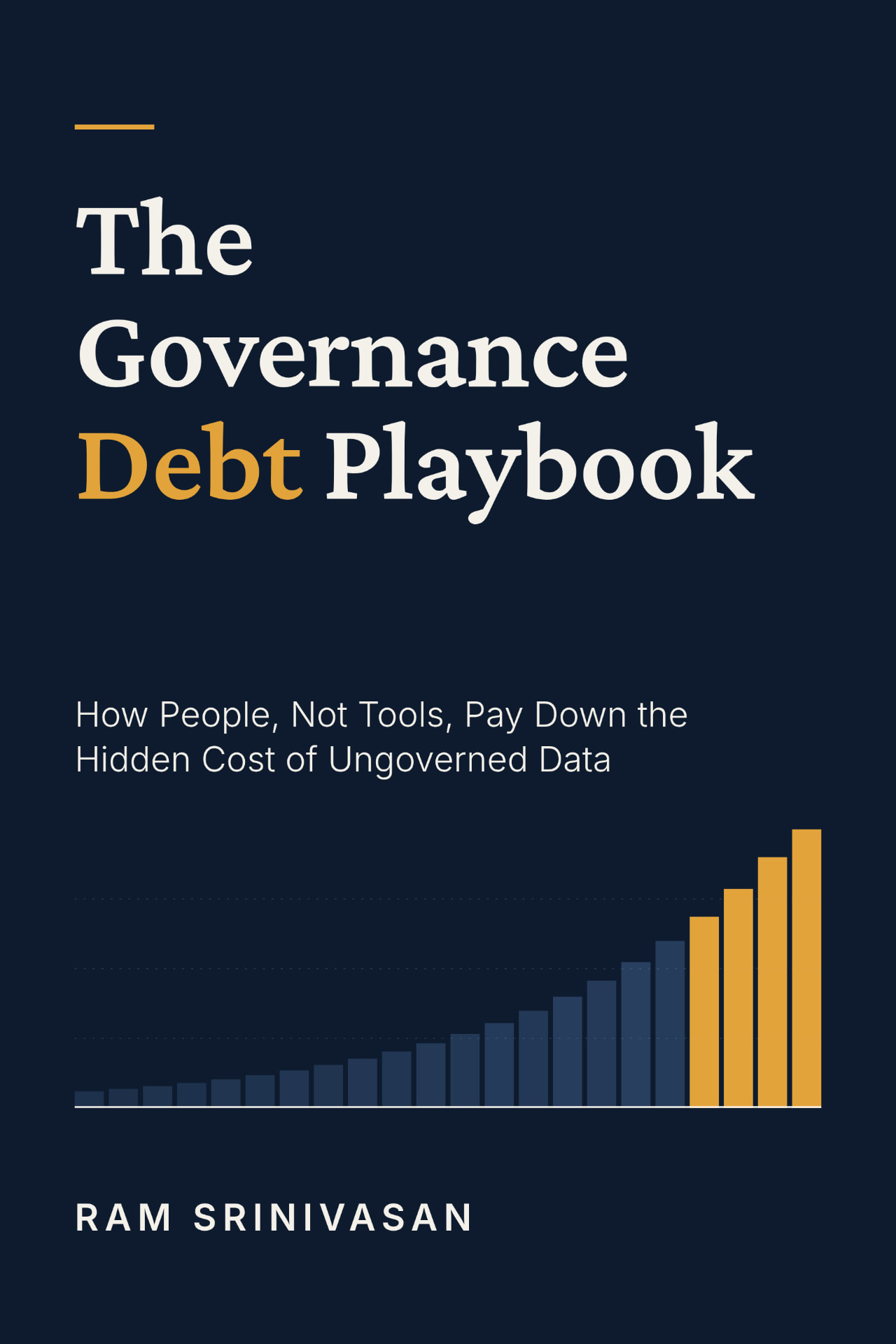
The Governance Debt Playbook
How People, Not Tools, Pay Down the Hidden Cost of Ungoverned Data
by Ram Srinivasan
Formats: Paperback and Kindle
The bill you did not know you were paying
Every organization I have worked with carries governance debt. It rarely shows up on a budget line. It shows up as the meeting that starts with an argument over whose number is right, the analyst who rebuilds every report because they do not trust the source, and the AI project that waits weeks for someone to approve the data it uses.
After more than 20 years in data governance, I have come to believe that most of this debt is not technical. It is people debt. Owners who were named on a chart but never asked to decide anything. Stewards who were given the role without anything taken off their plate. Decisions that sit with a committee because no single person owns them.
That is the idea behind my new book, The Governance Debt Playbook: How People, Not Tools, Pay Down the Hidden Cost of Ungoverned Data.
Why people avoid governance
For many people, governance is a four-letter word. It means bureaucracy, policing, and being blamed for problems they did not cause. So they avoid it. They build their own spreadsheets, decline ownership, skip the meetings, and call everything "IT's problem."
That avoidance is not a character flaw. It is a reasonable response to governance that has been slow, unhelpful, or punishing. But it adds to the debt every day, and it makes the debt compound. The book spends a full chapter on how to change that experience so people stop routing around it.
What is in the book
The book follows four steps.
Find it. The five types of governance debt, how good people take it on under pressure, and the people model that keeps it under control, built on one rule: every data decision has exactly one person accountable for it.
Measure it. A simple scoring worksheet and a sample calculator that prices the debt in your own numbers, with no invented benchmarks.
Fund it. Why AI, regulators, and lineage requests call the debt in, and how to get a yes from executives, the budget holder, and the board.
Pay it down. A 90-day plan built on one owner and one outcome, the habits that make it stick, and a light operating cadence to keep it paid down.
There are templates in the appendices you can copy: a self-assessment, a calculator template, role charters with a RACI, a 90-day plan, and a lineage scoping worksheet.
Who it is for
It is for data leaders and governance leads, data owners and stewards, and the executives and board members who depend on trusted numbers. It is especially useful if you have an AI launch, an audit, or a migration coming up.
It is a short, practical book. Plain words, short chapters, and a checklist in every chapter. Read it on a flight. Use it on Monday.
The Governance Debt Playbook is available in paperback and Kindle.
Ram Srinivasan is a Data Governance & Strategy Leader with more than 20 years of experience, Founder of Logical Leap, and author of the Simple Data series and The Governance Debt Playbook.